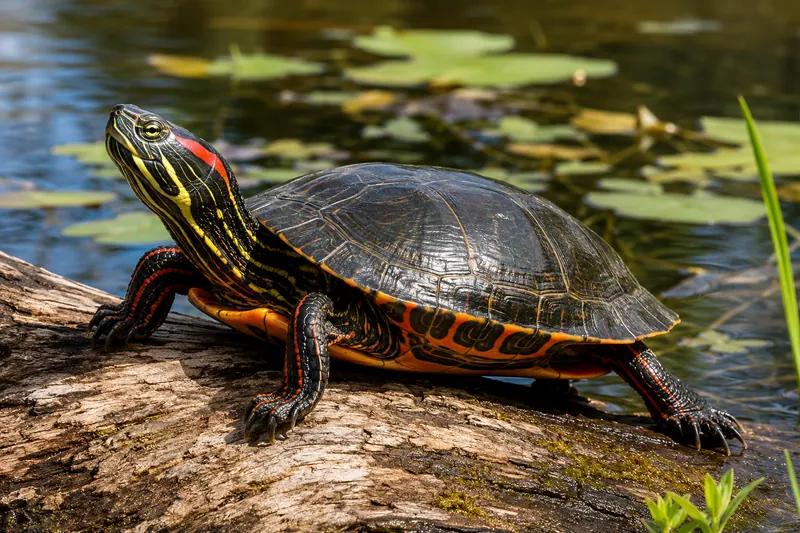
🐢 Painted Turtle Care Guide
Painted turtles are colorful, active North American aquatic turtles that spend much of their time swimming, foraging and basking. Although smaller than some commonly kept sliders, adults still require a substantial volume of clean water, strong filtration, a dry basking area, heat and UVB lighting.
🏠 Enclosure
Provide a large watertight aquatic enclosure with approximately 10 gallons of swimming water per inch of shell length. Because painted turtles can approach 10 inches, plan for roughly 100 gallons of water for a large adult. Provide an easily accessible land and basking area where the turtle can completely leave the water and dry off.
🌡 Heat
Basking surface 95–104°F • Juvenile water 78–80°F • Subadult/adult water 70–76°F
💧 Humidity
Ambient humidity is less important than maintaining clean water, appropriate water temperature and a completely dry basking area.
☀️ UVB / Lighting
Required — provide appropriate linear UVB over the basking area along with bright daytime lighting and a heat source.
🍽 Diet
Omnivore — offer an age-appropriate combination of quality aquatic turtle pellets, leafy greens and other appropriate plant matter, plus varied animal-based foods. Adults generally eat proportionally more vegetation than juveniles.
📅 Daily / Routine Checks
- Check water and basking temperatures
- Check filtration, lighting and other equipment
- Provide food according to age and feeding schedule
- Observe swimming, basking, appetite, eyes, skin and shell
🗓 Weekly / Regular Tasks
- Assess or test water quality
- Remove accumulated waste and debris
- Perform appropriate water changes and filter maintenance
- Clean and inspect the basking area
- Inspect shell and overall body condition
✓ Good Fit For
Someone who enjoys maintaining aquatic habitats, has room for a large enclosure and wants an active daytime turtle that can be observed swimming, feeding and basking.
⚠ Think Twice If...
Think twice if you want a small aquarium or low-maintenance pet. Painted turtles can live for decades and require substantial water volume, filtration, regular water maintenance, heat, UVB and long-term space.
This is a general planning guide intended to help prospective keepers understand the commitment involved before getting an animal. Husbandry needs can vary with age, health, enclosure design, geographic location and individual animals.
Research current species-specific husbandry and establish care with an experienced reptile veterinarian when appropriate.
📚 Sources & Further Reading
Husbandry recommendations are reviewed against current reptile-care resources.
Think you've found the right reptile?
ReptiTrak can help organize feeding, growth, sheds, health, enclosure records and reminders from day one. Free for up to 3 animals.