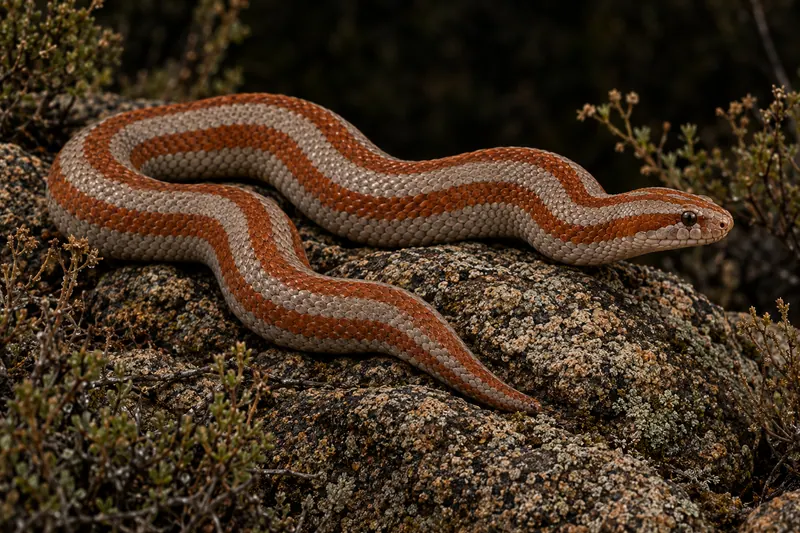
🐍 Rosy Boa Care Guide
Rosy boas are small, slow-moving desert boas with smooth scales and soft stripes. They rarely bite, tolerate handling well and need only a modest, dry enclosure.
🏠 Enclosure
Minimum formula: snake length × half its length × half its length. For a 44-inch adult that is 48 × 24 × 24 inches; smaller localities need less. House individually, with warm and cool hides, a humid hide and climbing rocks.
🌡 Heat
Basking surface 85–90°F • Cool side 75–80°F • Night temperatures can safely drop to about 60°F. Turn heat off at night. Rosy boas are usually cooled (brumated) in winter.
💧 Humidity
Keep humidity below 60% and the enclosure mostly dry — rosy boas are sensitive to wet conditions. Provide a humid hide on the cool side and mist occasionally to encourage drinking.
☀️ UVB / Lighting
Recommended — low-intensity UVB spanning ⅓–½ of the enclosure on the warm side, giving UVI 2–3 in the basking area.
🍽 Diet
Carnivore — frozen-thawed whole prey totaling about 10% of body weight, no wider than 1.5× the snake’s widest point. Juveniles every 5–7 days; adults every 10–14 days.
📅 Daily / Routine Checks
- Check temperatures and equipment
- Provide fresh, clean water in a small bowl
- Spot-clean feces and urates
- Observe activity and general condition
🗓 Weekly / Regular Tasks
- Offer prey on the feeding schedule
- Scrub and disinfect the water bowl
- Check that the enclosure is staying dry
- Record weight
✓ Good Fit For
A beginner who wants a gentle, easy-to-handle snake that stays small and lives a long time.
⚠ Think Twice If...
Think twice if you cannot keep the enclosure dry or are not prepared for a 30+ year commitment. Plan for a winter cool-down period, which they are adapted to.
This is a general planning guide intended to help prospective keepers understand the commitment involved before getting an animal. Husbandry needs can vary with age, health, enclosure design, geographic location and individual animals.
Research current species-specific husbandry and establish care with an experienced reptile veterinarian when appropriate.
📚 Sources & Further Reading
Husbandry recommendations are reviewed against current reptile-care resources.
Think you've found the right reptile?
ReptiTrak can help organize feeding, growth, sheds, health, enclosure records and reminders from day one. Free for up to 3 animals.