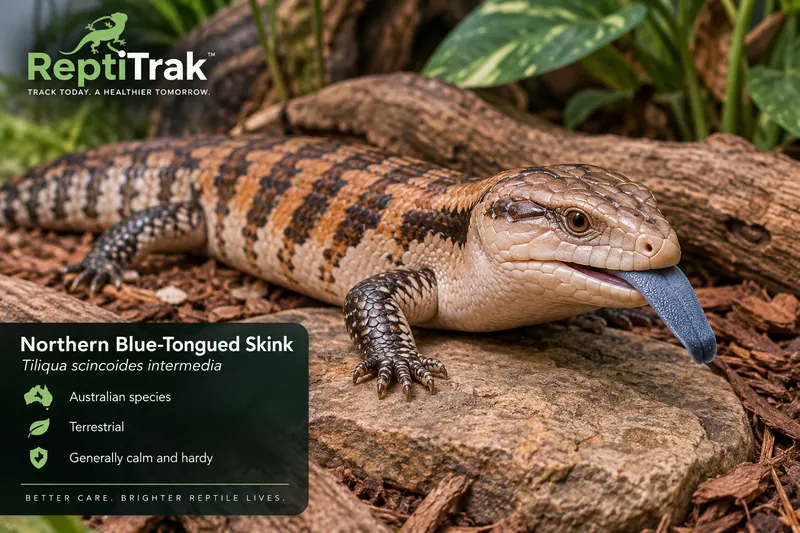
🦎 Northern Blue-Tongued Skink Care Guide
Northern Blue-Tongued Skinks are large Australian terrestrial lizards known for their heavy build, calm demeanor and bright blue tongue. Compared with Indonesian forms, they generally prefer a drier environment and higher basking temperatures.
🏠 Enclosure
Adults need a large terrestrial enclosure with substantial floor space. Current best-practice guidance calls for roughly 12 sq ft of floor area; 6 × 2 × 2 ft is one practical example.
🌡 Heat
Basking surface about 105–115°F with a cooler retreat available.
💧 Humidity
Generally about 40–60% ambient humidity.
☀️ UVB / Lighting
Recommended — provide appropriate UVB over the basking zone.
🍽 Diet
Omnivore — balanced animal protein, leafy greens and vegetables, with feeding frequency adjusted for age and body condition.
📅 Daily / Routine Checks
- Check basking and cool-side temperatures
- Check humidity
- Provide clean drinking water
- Spot-clean waste
- Observe appetite, activity and behavior
🗓 Weekly / Regular Tasks
- Prepare a varied omnivorous diet
- Inspect substrate and hides
- Clean food and water dishes thoroughly
- Inspect skin, claws and body condition
✓ Good Fit For
Someone looking for a substantial, interactive terrestrial lizard and who has room for a large enclosure and proper heating and UVB.
⚠ Think Twice If...
Think twice if space is limited or you want a reptile with very low heating, enclosure or food costs.
This is a general planning guide intended to help prospective keepers understand the commitment involved before getting an animal. Husbandry needs can vary with age, health, enclosure design, geographic location and individual animals.
Research current species-specific husbandry and establish care with an experienced reptile veterinarian when appropriate.
📚 Sources & Further Reading
Husbandry recommendations are reviewed against current reptile-care resources.
Think you've found the right reptile?
ReptiTrak can help organize feeding, growth, sheds, health, enclosure records and reminders from day one. Free for up to 3 animals.